
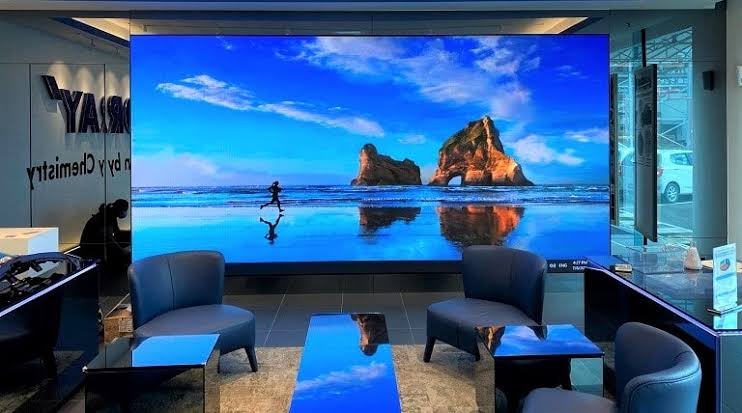
In an era driven by high-definition visual communication, static signs, standard projection screens, and grid-heavy LCD video walls are rapidly giving way to seamless display solutions. Whether in corporate boardrooms, luxury retail flagships, broadcast studios, or command centers, high-resolution indoor LED screens deliver unmatched brightness, vibrant contrast, and continuous, bezel-free canvases.
Unlike outdoor displays built to withstand heavy weather, indoor screens prioritize fine resolution, color fidelity, silent thermal performance, and low-latency processing. Understanding how these systems operate, how pixel pitch dictates viewing clarity, and how modern packaging methods like Chip-on-Board (COB) are shifting the industry empowers buyers to select the ideal setup for their space.
What is an Indoor LED Screen?
An indoor LED screen is a direct-view display system built from interconnected modular panels (cabinets). Each panel houses arrays of tiny light-emitting diodes mounted directly onto printed circuit boards (PCBs). Because direct-view LEDs emit light toward the audience without relying on an external backlight or projection beam, they produce pure blacks, high contrast ratios (10,000:1+), and wide viewing angles up to 170.
Essential Architectural Components
- Direct-View Modules: Small, magnetically attached tiles containing the diodes and integrated driver circuits.
- Die-Cast Cabinets: Ultra-lightweight structural frames (often made of magnesium alloy) designed to align tiles with sub-millimeter precision.
- Receiving Cards: Internal processing units that parse raw digital video signals and route driving data to every pixel.
- Video Processors: External hardware that scales, crops, and maps video feeds (HDMI, DisplayPort, SDI) to match the screen’s exact canvas resolution.
Surface Packaging Technologies: SMD vs. COB vs. MicroLED
The manufacturing process behind LED diode packaging plays a primary role in structural durability, pixel density, and visual performance.
1. Surface-Mounted Device (SMD)
In traditional SMD displays, individual red, green, and blue diodes are encapsulated inside a plastic housing and soldered onto the PCB face. SMD remains the dominant technology for pixel pitches above P1.8mm due to lower manufacturing costs and straightforward module repair.
2. Chip-on-Board (COB) Encapsulation
COB technology represents a major leap forward for fine-pitch displays. Instead of soldering packaged diodes, microscopic LED flip-chips are bonded directly to the substrate board and covered in a clear resin layer.
- Impact Resistance: The flat resin coating provides strong protection against physical impacts, static electricity, moisture, and dust.
- Better Heat Dissipation: Direct substrate bonding lowers thermal resistance, extending operational lifespans up to 100,000 hours.
3. MicroLED Integration
MicroLED represents the ultra-fine-pitch tier (typically P0.4mm to P0.9mm). Using microscopic LED chips (smaller than 100 micrometers), MicroLED offers vast color gamuts ($115\%+\text{ NTSC}$), deep black levels, and high contrast ratios. It is the preferred choice for broadcast sets, luxury cinema installations, and executive presentation rooms.
Critical Technical Metrics for Indoor Displays
Selecting the right screen configuration requires matching key hardware specifications to the physical dimensions and viewing dynamics of your room.
Pixel Pitch (P) and Distance Calculations
Pixel pitch represents the distance in millimeters between the centers of two neighboring pixels. Choosing the correct pitch prevents viewers from seeing individual pixel dots while keeping project costs within budget.
A reliable industry baseline for optimal viewing distance is:
OptimalViewingDistance(Meters)PixelPitch(mm)2.0
Refresh Rate and Camera Capture
Standard video displays refresh at 1,920Hz. However, if the screen will be filmed—such as during virtual production, live broadcasts, or televised corporate presentations—a minimum refresh rate of 3,840Hz to 7,680Hz is necessary. Higher refresh rates eliminate moiré patterns, scan lines, and image flickering on camera.
Common-Cathode Power Architecture
Modern indoor LED screen frequently utilize common-cathode power distribution instead of traditional common-anode systems. Common-cathode driving precisely regulates power supply to red, green, and blue diodes separately:
- Reduces panel heat generation by up to $30\%$
- Prevents thermal expansion that could misalign module seams
- Cuts overall operational energy consumption
Top Application Environments for Indoor LED Screens
The adaptability of modular LED panels allows them to be installed across many architectural spaces:
1. Corporate Executive Boardrooms and Auditoriums
Replacing traditional ceiling projectors with fine-pitch P1.2mm to P1.5mm LED walls provides clear visibility even in full ambient sunlight. Native 16:9 cabinet dimensions allow teams to display 1080p, 4K, or multi-window video streams without distortion.
2. Control Rooms and Network Operations Centers (NOC)
In mission-critical environments like utility monitoring hubs and security command centers, screens run 24 hours a day, 7 days a week. Ultra-fine pitch COB displays deliver crisp text rendering, high grayscale levels, and fanless operation for silent, distraction-free work environments.
3. High-End Retail and Flagship Showrooms
Brands use custom curved, angled, or pillar-wrapped LED screens to capture foot traffic and display motion graphics. Smooth front-service access ensures maintenance teams can swap modules in minutes without removing adjacent panels.
4. Interactive LED Floors and Immersive Rooms
Advanced installations pair high-load-bearing floor tiles (2,000kg/m2 weight capacity) with optic sensors. These interactive displays track user footsteps to trigger dynamic visual effects in museums, trade shows, and experiential retail hubs.
Planning Your Indoor LED Project: Step-by-Step
A successful installation requires careful planning across several stages:
Step 1: Evaluate Spatial Mechanics and Mounting Options
Determine how the video wall will be mounted:
- Direct Wall-Mounting: Uses slim sub-frames attached directly to load-bearing concrete or stud framing.
- Free-Standing Floor Frames: Ground-stacked support structures anchored to concrete floors.
- Recessed Flush Mounting: Displays built into wall cavities for a sleek, architectural finish.
Step 2: Ensure Front-Service Maintenance Access
Always select indoor cabinets with 100% magnetic front maintenance. Vacuum-assisted extraction tools allow technicians to remove modules, replace power units, and service receiving cards from the front, saving time during repairs.
Step 3: Calculate Electrical and HVAC Loads
Work with structural and electrical engineers to verify:
- Peak vs. Average Power: Calculate total circuit draw based on average consumption (typically 150–200 Watts per square meter).
- Thermal Load (BTU): Ensure room air conditioning can comfortably handle the thermal output during continuous operation.
Conclusion
Indoor LED screen technology offers superior visual clarity, long-term operational reliability, and total structural flexibility. By understanding pixel pitch formulas, packaging advances like COB, and key power and service requirements, you can build a high-performance visual display that captivates your audience for years to come.
