
For years, social media performance was often judged by surface-level engagement. Brands celebrated likes, shares, comments, and follower growth because those numbers were visible and easy to track. While engagement still matters, it does not always translate into meaningful business demand. A post can perform well in the feed and still do very little to influence how customers think about a problem or whether they eventually consider a product.
This is why social media content is becoming more important as a demand generation asset. The strongest content does not simply attract attention; it helps audiences understand a problem, recognize a need, evaluate new approaches, and become more receptive to a solution. When content consistently does that, social media starts influencing demand long before a customer reaches a landing page.
Demand Begins Before the Buyer Is Ready to Buy
Most potential customers are not actively shopping at any given moment. They may be aware of a frustration, inefficient workflow, or emerging challenge, but they have not yet decided that the problem deserves budget or attention. Traditional performance marketing often struggles in this stage because there is no immediate intent to capture.
Social media is particularly powerful here because it can reach audiences before formal buying intent exists. A useful post can introduce a new way of thinking, explain why an old process is inefficient, or reveal a problem the audience had normalized. Over time, repeated exposure can turn vague discomfort into a clearly understood need.
This is the beginning of demand creation. Instead of waiting for customers to search for a solution, brands use content to help shape how the market understands the problem. By the time the buyer becomes active, the brand may already be part of the mental shortlist.
Category Education Can Create Future Buyers
This is especially important in emerging categories. When a product introduces a new workflow, a new technology, or a new way of solving a familiar problem, the market often needs education before it needs a sales pitch. Customers cannot buy what they do not yet understand.
Strong content helps close that gap. Brands can explain why the old approach is limiting, what has changed in the market, and how a newer model works. This educational layer gives potential customers the context required to understand the product’s value.
For AI and SaaS companies, category education can be one of the most effective uses of social media. The content may not convert immediately, but it can create the conditions that make future conversion possible. That makes educational content strategically valuable even when the short-term metrics look modest.
Social Media Can Shape Buyer Intent
Buyer intent is often treated as something that already exists and simply needs to be captured. In reality, intent can also be influenced. The content a person sees over time affects which problems feel urgent, which solutions appear credible, and which brands feel familiar.
A company that repeatedly publishes strong insights around a specific challenge can gradually increase the perceived importance of that challenge. If the content also explains a better way forward, the audience begins to connect the problem with a solution category. That process creates a more informed and more motivated buyer.
This is why brands should think beyond click-through rates. A post may influence a future buying decision without generating an immediate action. The value appears later, when the customer already understands the problem and recognizes the brand.
AI Makes Demand-Focused Content Easier to Scale
Building demand through content requires consistency. One article or one video is rarely enough to change how a market thinks. Brands need repeated educational touchpoints across different formats, platforms, and stages of awareness.
AI can help make that repetition more sustainable. Modern systems can assist with idea generation, content adaptation, platform-specific formatting, visual creation, and publishing. This allows teams to maintain a steady flow of educational and perspective-driven content without manually rebuilding every asset from scratch.
Platforms such as social media content solution Spira AI fit naturally into this model. By connecting creation, publishing, automation, AI-powered personas, and ongoing social activity, Spira AI can support the kind of continuous communication required to build demand over time.
Spira AI Supports Always-On Market Education
Market education works best when it is ongoing. If a brand explains a category once and then disappears, the audience may forget the message before it becomes relevant. Continuous publishing gives the company more opportunities to reinforce the same strategic idea from different angles.
Spira AI is relevant because its broader workflow supports persistent social activity rather than isolated content generation. Brands can create, adapt, and publish content more continuously while maintaining a clearer connection between the message and the overall brand strategy. That makes it easier to educate the market at scale.
This kind of always-on communication is particularly valuable for companies in fast-moving categories. AI, automation, creator technology, and social platforms evolve quickly, which means audiences need regular context. A brand that helps explain those changes can become a trusted reference point.
Educational Content Should Lead, Not Push
Demand generation works differently from aggressive promotion. The goal is not to force a sale before the audience is ready. It is to help the audience understand enough that interest develops naturally.
The best educational content gives value before it asks for anything. It can explain a trend, break down a workflow, compare approaches, or clarify a common misconception. Over time, this creates a relationship in which the audience sees the brand as useful rather than intrusive.
That relationship matters because trust often precedes intent. When the customer eventually decides to evaluate a solution, the brand that has already provided useful education has a significant advantage. The audience does not need to start from zero.
AI Influencers Can Expand Demand Creation
AI influencers can add another layer to demand generation by giving brands more recognizable ways to educate different audience segments. A digital persona can focus on one area of expertise, one industry, or one type of customer problem. This allows the brand to communicate with greater specificity.
Spira AI’s emphasis on AI-powered personas makes this particularly relevant. One persona can focus on educational content, another on trends, and another on practical use cases. Each can support a different stage of audience awareness while remaining connected to the same broader brand strategy.
This structure can make content feel less like corporate broadcasting and more like ongoing media. When the persona consistently delivers useful information, it can help build familiarity and curiosity around the category. That makes demand creation more scalable.
Demand Generation Requires Content for Different Awareness Levels
Not every customer needs the same message. Some people are only beginning to recognize a problem, while others already understand the category and are comparing solutions. A strong content strategy should support multiple stages of awareness.
At the earliest stage, content should focus on the problem. It can highlight inefficiencies, changing market conditions, or new opportunities. At later stages, content can explain approaches, use cases, workflows, and product advantages.
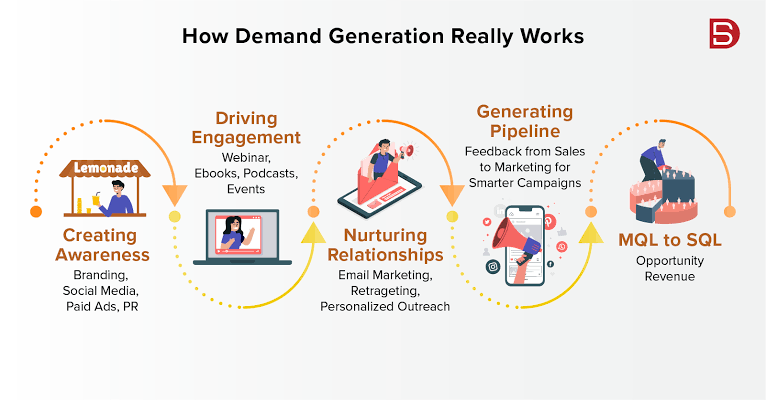
This creates a more complete demand journey. Instead of pushing every audience member toward the same call to action, the brand provides the information most relevant to where the buyer is. Over time, that makes the transition from awareness to consideration feel more natural.
Engagement Should Be Interpreted Through Business Context
High engagement can be useful, but it should not be treated as the final objective. A post that generates many reactions from an irrelevant audience may be less valuable than a smaller post that reaches the right decision-makers. The quality of attention matters.
Brands should therefore interpret social performance through business context. Which topics attract potential buyers? Which educational messages lead to profile visits, product interest, or deeper conversations? Which formats bring the right audience closer to understanding the solution?
AI can help teams identify these patterns more efficiently. Instead of optimizing only for the largest numbers, marketers can focus on the content that appears to influence the right type of demand. That creates a more strategic relationship between analytics and growth.
Social Content Can Reduce the Cost of Future Acquisition
One of the long-term benefits of demand generation is that it can make future acquisition more efficient. A customer who already understands the category and recognizes the brand requires less education when they enter the buying process. Sales and performance marketing do not have to do all the work from the beginning.
This can improve the effectiveness of paid campaigns as well. Ads perform differently when the audience has already seen useful organic content and understands the brand’s point of view. Familiarity reduces uncertainty and gives the paid message more context.
In this way, social media content becomes part of the acquisition infrastructure. It may not receive direct credit for every conversion, but it can make other growth channels more effective. That indirect value is easy to underestimate.
The Future of Social Media Content Is Demand Creation
As content production becomes easier, publishing volume alone will become less meaningful. More brands will be able to produce polished posts, videos, and visuals at scale. The real advantage will come from using that capacity to shape how the market thinks.
Brands that educate well can make customers more aware of problems, more interested in new solutions, and more confident in emerging categories. That is a much more valuable outcome than temporary engagement because it influences future buying behavior.
Spira AI fits naturally into this future by supporting the continuous creation and publishing required for long-term market education. The biggest opportunity is not simply to generate more content, but to build a system that consistently turns attention into understanding, understanding into intent, and intent into future demand.
