
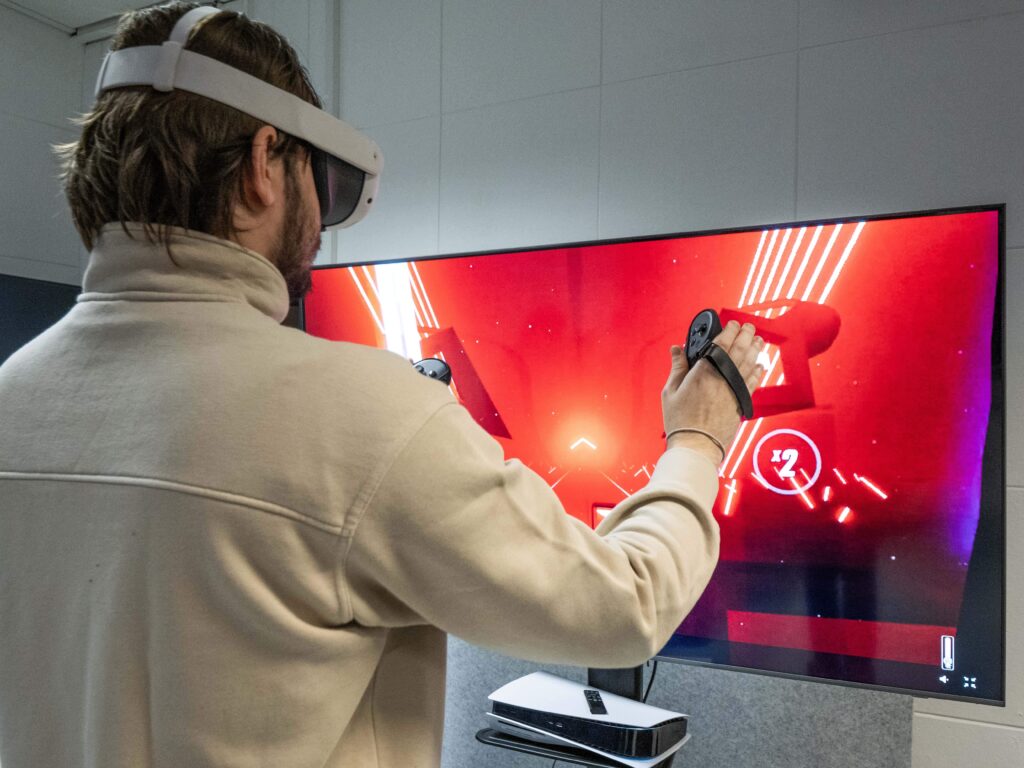
Virtual reality has a locomotion problem, and it has had it since the first headset. Players can look anywhere and reach for anything — but the moment a game asks them to walk, the illusion collides with the living-room wall. Solutions have ranged from teleportation mechanics to thumbstick gliding that leaves a share of users queasy. The Virtuix Omni One, an omnidirectional treadmill now bundled with Meta Quest hardware through Meta’s Quest platform, is the most consumer-serious attempt yet to solve the problem with hardware instead of workarounds.
The bundle matters to our gaming coverage because of what it signals: the VR platform holder and the leading locomotion specialist are now selling a single box. That is the console-accessory model arriving in VR, and it changes the calculation for developers deciding whether to build for natural movement.
How the Omni One Works
The Omni One is a compact, dished platform used with low-friction overshoes and a support harness. The dish lets your feet slide in any direction while the harness keeps you centred; sensors translate your stride — walk, run, crouch, jump-in-place — into game movement. Virtuix refined the design over years of location-based entertainment, where Omni systems ran in arcades and family entertainment centres, accumulating durability data from millions of public sessions before the home version shipped.
The practical result is locomotion that uses your legs rather than your thumbs. Players report that presence — the felt sense of being inside the world — jumps when movement is physical, and the exercise is not trivial: an hour of treadmill VR is a genuine workout, a selling point Virtuix leans on with its fitness-oriented titles.
Why the Meta Bundle Changes the Market
Peripherals die without content, and content needs an installed base worth building for. Previous locomotion devices fragmented across headsets and platforms; a Quest bundle unifies the target. Developers get one specification — one tracking model, one storefront, one audience — which is exactly the condition that turned console accessories from novelties into categories in previous hardware generations.
The bundle also clarifies the buyer. This is not an impulse purchase; it is aimed at the dedicated end of the Quest audience — fitness gamers, simulation enthusiasts, and households where VR is a hobby rather than a party trick. Pricing positions it against other premium hobby hardware rather than against the headset itself.
The Hurdles That Remain
Space, noise and price are the honest objections. The Omni One needs a dedicated footprint, downstairs neighbours will hear a running session, and the total cost of treadmill plus headset reaches well into enthusiast territory. The catalogue, while growing, must sustain a release cadence through the first year to justify the shelf space the hardware occupies.
The Arcade Proving Ground
Virtuix’s route to this bundle ran through location-based entertainment, and that history is written into the product’s design decisions. Consumer hardware designed in a lab fails in the field in a hundred small ways — harness wear, sensor drift, hygiene, throughput. Years of arcade operation, where Omni rigs ran paying customers back-to-back for entire days, burned those lessons in before the home unit was finalised. The company effectively sold its research and development to arcades before selling the product to consumers.
That pedigree is the bundle’s quiet argument to sceptics: this is not a crowdfunding prototype seeking its first real-world test. The test ran for years, in public, at scale — and the home version is what survived it.
None of that diminishes the milestone. For a decade, VR walking has been a trade-show demonstration; the bundle makes it a retail product with platform backing. Whether it becomes a category or a cult will be decided by software — but the hardware argument, at last, is settled. More VR hardware analysis lives in our gaming section.
