
Someone sends you an address in Bangkok and it reads like a coordinate from a game you have not played: 22 Sukhumvit Soi 8, Khlong Toei. There is no house number you recognise, no street name you can picture, and the map on your phone shows one enormous road with dozens of identical-looking stubs coming off it.
The system is actually simple, and ten minutes of understanding it saves a week of wrong turns.
The numbering is the whole trick
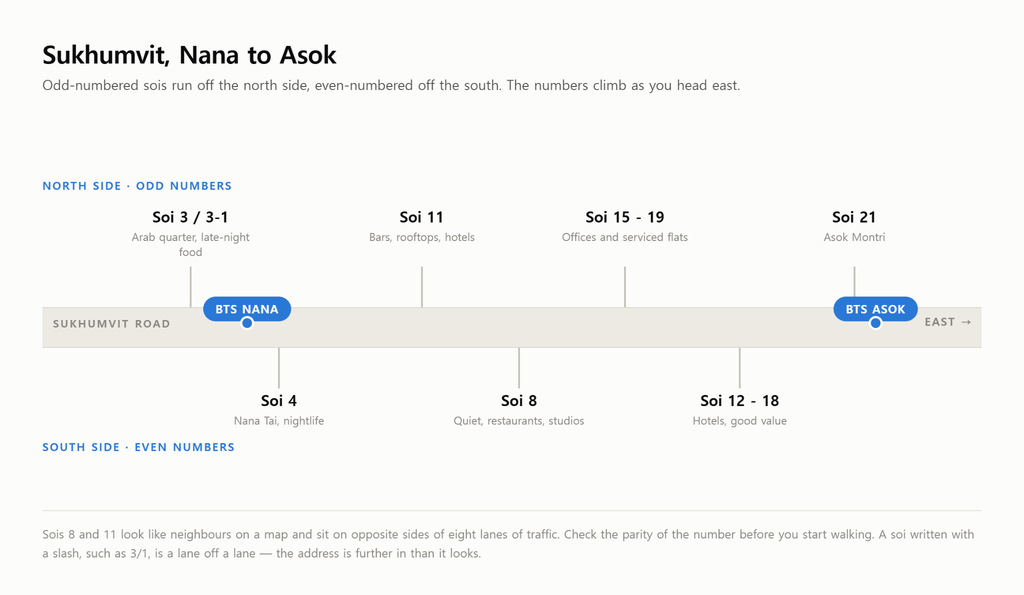
Sukhumvit is a single road running roughly east. Everything branching off it is a soi — a side street — and each one is numbered rather than named. The numbers climb as you head east, and they alternate by side: odd-numbered sois run off the north side of the road, even-numbered ones off the south.
So Soi 8 and Soi 11 are not neighbours. They are near each other on the map, but on opposite sides of eight lanes of traffic, and crossing in the wrong place costs you fifteen minutes and a lot of patience. Check the parity before you start walking, not after.
One more wrinkle. A soi can have its own branches, written with a slash or a dash — Soi 3/1, Soi 23/2. These are lanes off the lane. If an address has one, the destination is further in than you think, and the walk from the main road can be five minutes.
The Skytrain is the spine
Forget distances in kilometres and think in stations. The BTS Skytrain runs directly above Sukhumvit, and three stops cover almost everything a short-trip visitor needs: Nana, Asok and Phrom Phong, in that order heading east.
Nana sits above Soi 4. Asok sits above Soi 21, at the city’s busiest intersection. Phrom Phong is at Soi 24 and marks the start of the quieter, more residential stretch. If you can remember those three numbers, you can place any address on the strip instantly: Soi 8 is between Nana and Asok, closer to Nana; Soi 33 is past Phrom Phong.
Trains stop running around midnight. That single fact shapes more evenings than anything else on this list.
Odd north, even south, numbers climbing east. Three station numbers place any address on the strip.
Nana to Asok, soi by soi
Soi 3 and 3/1. The Arab quarter. Shawarma, Egyptian and Lebanese kitchens, shisha cafes, and the most reliable late-night food on the strip. Busy until dawn, and not remotely a nightlife street in the way visitors expect.
Soi 4. Directly under Nana station and the densest concentration of bars on the lower sois. Loud, well lit, and a useful landmark even if you have no intention of stopping.
Soi 8. One of the quieter even-numbered sois. A mix of apartment blocks, small restaurants, a couple of hotels, and the kind of independent studios and salons that have signs rather than frontage. It is a two-minute walk from Nana station but feels several streets removed from it — which is exactly why people who stay on Sukhumvit more than once tend to end up on sois like this one.
Soi 11. The street most guidebooks mean when they say “Sukhumvit nightlife”. Rooftop bars, boutique hotels, a steady stream of taxis. Walkable from Nana, loud until late.
Soi 13 to 19. Hotels, serviced apartments and office towers. Little atmosphere, good value, five minutes from both stations.
Soi 21 (Asok Montri). The major crossroads. Terminal 21 mall sits on the corner, the MRT underground line meets the Skytrain here, and this is where you change trains for the rest of the city.
Reading the shopfronts
Walk any soi in this stretch and you will pass signs listing four or five words with prices beside them: massage, aroma, B2B, soapy, nuru. Almost nobody explains what separates them, and the price gap between the cheapest and the dearest line can be several thousand baht for the same hour.
Briefly: traditional Thai is clothed, dry and stretch-based; aroma is oil; soapy is bath-based with foam; and nuru uses a seaweed-derived gel and sits at the top of the price list. If you want the full breakdown before you are standing in front of a counter, the difference between soapy and nuru massage is set out properly elsewhere. The point for navigation purposes is simply that the word on the sign tells you the price bracket, so read it before you walk in.
Where to base yourself
For two or three nights, stay between Soi 4 and Soi 21. You are inside walking distance of two stations, the food runs all night, and you will never pay for a taxi you did not want.
Odd sois in that range put you closer to the bars. Even sois put you a street away from the noise, which most people prefer by the second night. Businesses on the quieter side of the road tend to publish their addresses with the soi number attached precisely because it is a selling point — 8 Fantasy on Sukhumvit Soi 8 is one of many that list it that way.
Getting home at night
Three things worth knowing in advance. Taxis are metered and cheap, but a driver who refuses the meter is a driver you walk away from. Motorbike taxis wait at the mouth of every soi in numbered orange vests, and for a long soi they are the fastest two minutes you will spend all day. And the pedestrian footbridges at the big intersections exist for a reason — crossing Sukhumvit at street level is not a thing locals do.
One more practical note. Soi addresses defeat map apps often enough that a phone call is still the fastest fix, and most places on the strip will talk a driver in. 8 Fantasy, at 22 Sukhumvit 8, Khlong Toei, Bangkok 10110, answers on +66 82 836 1625 and runs until 02:00 — well past the last train in either direction.
Learn the parity rule, memorise three station numbers, and the whole strip stops being a maze.
