
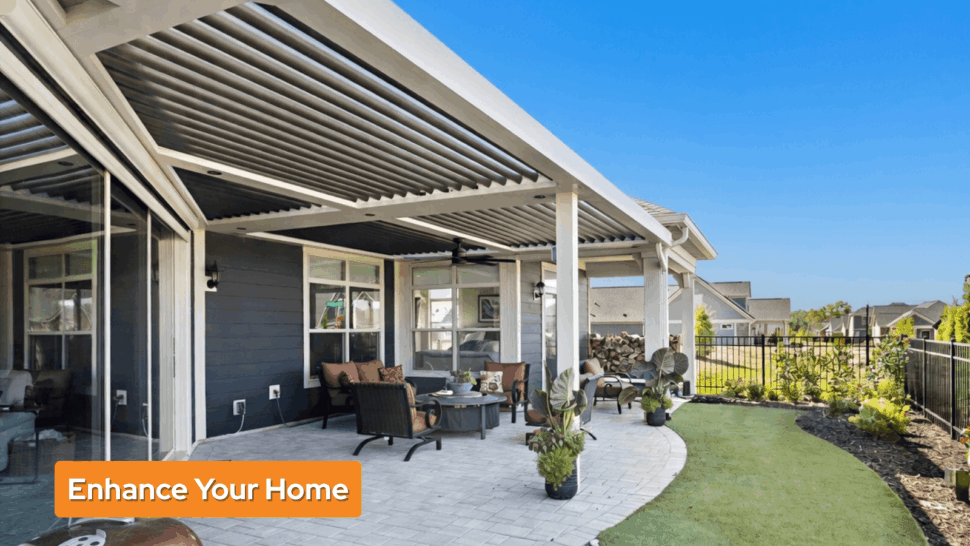
Summer on a Canadian patio is short and hard to predict. A calm afternoon in July can turn gusty within minutes as a lake breeze or a prairie front rolls through, and any shade structure left standing outdoors has to earn its place against that wind. Homeowners want cover from the sun without a roof that fights the weather every time the air moves.
A louvered pergola answers that problem differently from a fixed roof, because its shade comes from a bank of pivoting blades rather than one solid panel that the wind can grab.
Each blade behaves as a small beam against a gust
Wind does not press evenly on a flat roof. It slides across the top and lifts, in the same way air moving over an airplane wing lowers the pressure above it. A solid canopy catches that lift across its entire surface and strains at its anchors, and the failure you fear is being peeled upward rather than pushed over.
Breaking the roof into narrow blades changes the picture. When the blades close, their overlapping edges form a continuous surface, yet each blade still acts as a small beam supported at both ends by the side rails. Load flows into those rails instead of gathering at a single seam, so the roof answers both a downward gust and an upward pull without any one point taking the whole strain.
The material of the blades feeds into the same logic. Aluminum is light and does not rust, which keeps the moving parts free through wet Canadian summers, but a light roof is also easy for the wind to lift. That trade-off is precisely why the way the blades are held, and the way the frame is anchored, end up mattering more than the raw strength of any single piece.
Locked blades matter far more than merely closed blades
Closing the blades is not the same as securing them. If the pivots are left free, a strong gust can flutter the blades or force them open, and a fluttering blade hammers its own bearings until they loosen and wear. A patio owner who has heard that rattle through a windy evening knows the sound of a roof working against itself.
This is why the blades must lock at the limit of their travel, held firmly by the drive mechanism rather than resting loosely against a stop. A locked bank behaves as one rigid surface, and that single quality is what lets a louvered pergola shrug off a summer squall instead of clattering through it. Rigidity, not weight, is what keeps the roof quiet.
One handle turns an entire roof of blades together
The elegance of the design lives in the linkage. Every blade of a louvered pergola connects to a shared drive bar, so a single input rotates the whole bank through the same angle at once. Turn the handle and forty blades move as one, which is far harder to achieve than it looks.
Most systems reach that motion in one of a few ways, and each choice carries a trade-off worth weighing:
•Manual crank: simple, low cost, needs no power
•Worm gear drive: holds the angle firmly, resists back-driving
•Motorized actuator: effortless, adds wiring and expense
The worm gear is the quiet hero among them. Its geometry lets the handle turn the blades while blocking the blades from turning the handle, so wind cannot force the bank open once the angle is set. That one-way behavior is what turns a hand crank into a genuine lock, holding the roof wherever the operator leaves it.
The linkage also explains why the blades of a louvered pergola move so evenly. Because every blade shares the same drive bar, none can lag or lead its neighbor, and the bank closes into a flat plane rather than a set of gaps. A crew that has fought with a warped awning appreciates a roof that seats itself the same way every time, with no blade left ajar to whistle in the wind.
The opening angle is really an airflow valve
The reason to tilt the blades rather than simply open them is comfort. Fully closed blades trap warm air beneath the roof on a still day, while a partial tilt opens gaps along the whole bank that let hot air rise and escape. The same structure that sheds rain can breathe when the sky clears.
Angling the blades toward the low afternoon sun blocks direct glare while keeping the view overhead open. Read this way, the roof of a louvered pergola serves as sunshade, vent, and rain cover in turn, and which of the three you get depends only on how far the blades are rotated. A cook standing over a grill in August feels the difference when the heat above finally has somewhere to go.
Rain changes the calculation in an instant, and this is where the pivoting design shows its worth. A sudden shower calls for the blades to snap flat and shed water, while the same afternoon might end with them tilted wide to dump the trapped heat of the day. No fixed awning offers that range, because it commits to one setting the moment it is built.
Standing firm begins below the deck
Wind rarely topples a frame by crushing it. Instead it levers the structure over, pushing at the roof while the base acts as a pivot, so the posts must resist overturning rather than simple downward weight. The taller the frame, the longer the lever the wind is given, and exposure on an open yard multiplies the effect.
How the posts meet the ground therefore decides whether the frame stays put through a storm:
•Bolted to concrete footings: strongest against overturning
•Anchored to an existing slab: reliable on solid patios
•Free-standing on weighted feet: easiest, weakest in wind
On an open Canadian yard, footings poured below the frost line give the frame the deep, broad base it needs to stay level season after season, since frozen ground that heaves in winter would otherwise tilt a shallow anchor by spring. A frame set on a solid concrete slab enjoys much of the same stability, provided the fasteners reach into sound material rather than a thin surface layer. Matching the anchoring to the height and exposure of the site is the difference between a roof that lasts and one that slowly leans out of true.
Understood in these terms, a louvered pergola stops being a novelty and becomes a predictable machine, with every blade, gear, and footing doing a job that an owner can see, trust, and maintain.
