
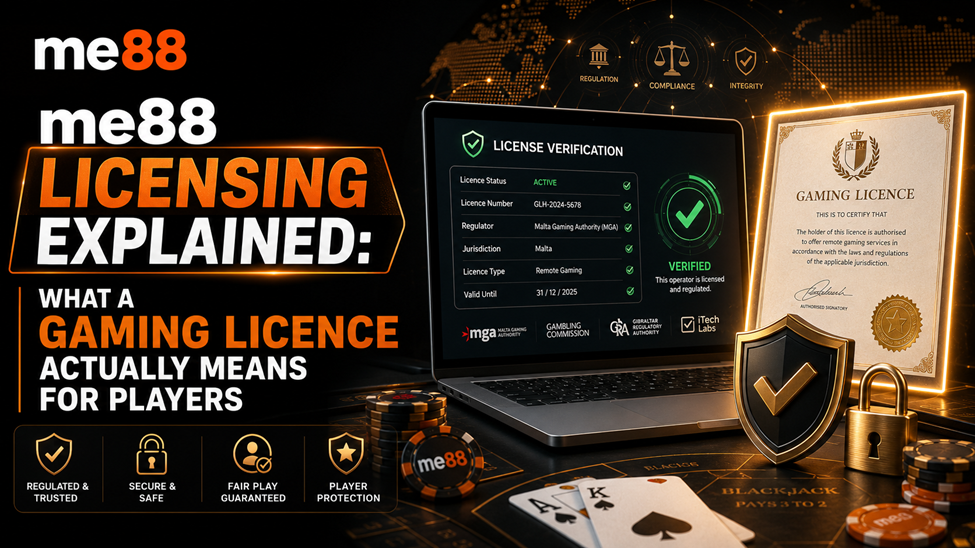
“Licensed and certified” appears on almost every gaming website — but few players know what those words actually protect. Is a licence just a badge in the footer, or does it change your experience in a real way? This guide breaks down what a gaming licence is, what RNG certification actually tests, and how you can tell genuine credentials from decoration.
What a gaming licence actually is
A gaming licence is a legal authorisation issued by a regulatory authority that permits an operator to offer real-money games under defined rules. Getting one is not a formality. Before a licence is granted, the operator typically has to demonstrate:
- Corporate transparency — who owns and runs the business, with background checks on key people.
- Financial standing — proof the operator can actually pay out player winnings, including segregated or protected player funds.
- Game fairness — evidence that game outcomes are random and not manipulated.
- Player protection measures — responsible gaming tools, age verification, and complaint procedures.
- Data and payment security — standards for how player information and transactions are protected.
Once licensed, the operator remains under ongoing supervision. Licences can be suspended or revoked, which gives the regulator genuine leverage: an operator that mistreats players risks losing the legal foundation of its entire business.
What a licence means for you as a player
Strip away the legal language and a licence gives players three practical things:
1. An accountability channel. If a dispute cannot be resolved with the operator directly, a licensing authority provides a formal complaint route. Unlicensed operators answer to no one.
2. Fairness you do not have to take on faith. Licensed operators are required to use certified random number generators and submit to independent testing — more on this below.
3. Rules about your money. Licensing regimes impose requirements on how player deposits are held and how withdrawals are processed, reducing the risk that your balance simply disappears.
The details of me88’s operating licence, the authorities involved, and the specific certifications held are published on the me88 license and certifications page, which is the authoritative source for the brand’s current credentials.
RNG certification: how fairness is actually tested
Every slot spin, card draw, and dice roll in digital games is produced by a random number generator (RNG) — an algorithm that generates unpredictable outcomes. Certification means an independent testing laboratory has examined that algorithm and confirmed three things:
- Randomness — outcomes cannot be predicted or patterned.
- Non-manipulation — neither the operator nor the player can influence results.
- Accurate payout behaviour — the game’s actual return-to-player (RTP) matches what is advertised.
Testing laboratories such as independent auditing bodies run millions of simulated game rounds and statistical analyses before issuing a certificate. Certification is also not a one-off event — games are re-tested periodically, and any change to game software can trigger re-certification.
This is the crucial difference between a certified platform and an uncertified one: on a certified platform, fairness is a measured, audited property. On an uncertified one, it is a promise.
Why the game providers matter as much as the operator
A detail many players miss: fairness certification largely lives at the game studio level. The slots and table games on any platform are built by third-party providers, and reputable studios certify their games independently before any operator can offer them.
This means a licensed operator working with established, award-winning studios is covered by two layers of scrutiny — the operator’s own licence, plus each provider’s independent game certifications. The studios and payment partners that power me88, and how they are selected for quality and fairness, are detailed on the partnerships and providers page.
When evaluating any gaming platform, the provider list is one of the fastest credibility checks available: recognised international studios do not risk their own certifications by working with rogue operators.
How to verify credentials yourself
A footer badge proves nothing on its own — phishing and clone sites copy badges freely. To verify properly:
- Go to the official brand source, not a link you were sent. Credentials published on a verified official page are meaningful; badges on an unverified page are just images.
- Check that licence details are specific. Genuine disclosures name the issuing authority. Vague claims like “fully licensed internationally” with no specifics are a warning sign.
- Look at the provider lineup. A roster of well-known, independently certified game studios is hard to fake at scale.
- Be sceptical of perfection claims. Real certification language talks about tested RTP ranges and audited randomness — not “guaranteed wins.”
The bottom line
A gaming licence is not decoration — it is the difference between a platform that answers to a regulator and one that answers to nobody. Combined with independent RNG certification and reputable game providers, it forms a verifiable chain of accountability: regulator → operator → testing lab → game studio.
As a player, you never have to take fairness on faith. The credentials are published, the testing is independent, and verification takes minutes when you start from the official source.
