

Standings explain why a match can matter far beyond its ninety minutes. On Cakhiatv, supporters can connect the next league fixture with the wider contest for points, positions, and season objectives. A draw might protect one club from danger while leaving another frustrated in a title race. Understanding the table makes those differences easier to recognize. Start with the basic columns, identify what each team is pursuing, then consider how the upcoming result could change the situation. That approach gives every league match a clearer competitive setting.
Read standings beyond the position number

Standings give football viewers useful league context
The number beside a club is a summary of several factors rather than a complete measure of its quality. Points matter most in many competitions, but games played, goal difference, and local tiebreaking rules also affect the picture. Read those details together before comparing two teams.
Connect points with games played
A team three points behind a rival may have played one fewer match. That does not guarantee it will close the gap, but it does mean the current difference needs context. Games in hand represent opportunities, not points already earned.
When reviewing standings, compare completed matches before describing a lead as comfortable or decisive. A busy cup schedule or a postponed fixture can leave clubs on unequal totals for several weeks. The league position is correct for the recorded results, yet the remaining opportunities may differ considerably.
Wins, draws, and defeats help explain how the points were accumulated. A club with many draws may be difficult to beat but still struggle to advance. Another might alternate wins and losses while collecting a similar total through a different pattern.
Check how equal points are separated
Do not assume every competition uses the same order of tiebreakers. Goal difference, goals scored, and head-to-head results can have different significance depending on the rules. Consult the relevant competition information when a close race makes that distinction important.
Reading standings carefully also means distinguishing a league table from a group-stage table or another competition format. Qualification conditions may depend on more than a familiar top-to-bottom ranking. A brief check of the format prevents a misleading interpretation of otherwise straightforward numbers.
Watch the number of remaining points available as the season approaches its end. A gap that looks small in isolation may become difficult to recover when only a few rounds remain. Equally, a leading position is not necessarily secure while rivals still have enough opportunities to overtake. Avoid declaring an objective settled until the relevant mathematical and competition conditions support that statement. This is particularly important when postponed games leave clubs with different schedules. The useful reading is a combination of what has already been earned and what remains possible, with neither part treated as though it guarantees future results.
Recognize the different contests within one table
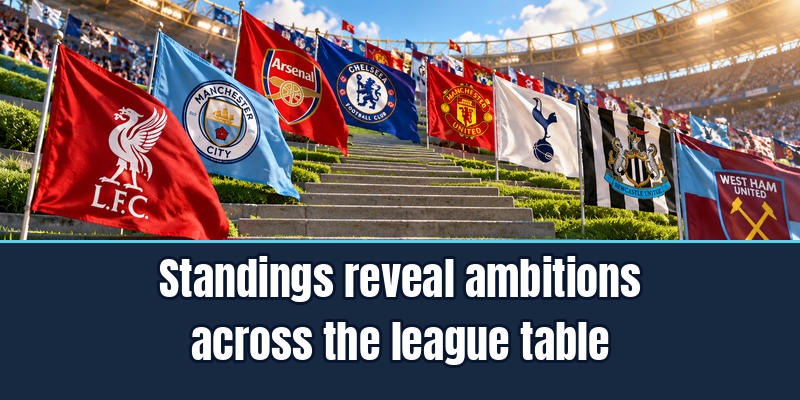
Standings reveal ambitions across the league table
A single table contains several overlapping competitions. Some clubs pursue the championship, others seek continental places, and another group concentrates on survival. Viewers gain useful context by asking what success would mean for each participant, rather than assuming that only the highest positions matter.
Titles and qualification places
Near the top, a small gap can influence how urgently a team approaches a direct rival. A draw may preserve an advantage for the leader while doing little for the chasing club. The result has different value because the clubs begin from different positions.
Use standings to identify those contrasting incentives. Qualification races can be just as demanding as the title contest, particularly when several clubs remain close together. Check the competition’s actual qualification arrangements rather than assuming that a particular finishing position always carries the same reward.
The number of remaining fixtures matters as well. An early-season gap leaves more opportunities for change than the same difference with two rounds remaining. Time gives the points their practical meaning.
Survival and pressure near the bottom
Relegation battles make meetings between nearby teams especially important. One result can improve a club’s position while denying points to a direct competitor. That combination explains why these games often receive attention beyond the quality suggested by the rankings.
However, standings should not be used to predict the emotional tone of every match automatically. A lower-ranked side might be improving, while another has a difficult remaining schedule. The table establishes the stakes; recent performances and upcoming opponents add context to the challenge.
Understand what one match could change in the standings

Standings show the possible impact of one result
Imagine a fictional league with three games remaining. Northbridge have 40 points, Riverside have 38, and Lakeside have 37. If Northbridge face Riverside, a home win would extend the gap between them to five points. An away win would move Riverside ahead. A draw would preserve their existing difference while giving Lakeside an opportunity to close it.
This is a useful way to read standings before kickoff. Consider each possible result separately rather than focusing only on which team is favored. The exercise explains why one side may value a point more than the other without claiming that either manager will choose a specific strategy.
Now add another detail: Lakeside have a game in hand. Their position still reflects fewer points, but their remaining route is different. The situation becomes more informative once the table is connected to the schedule instead of treated as a standalone verdict.
During a match, a provisional table may display positions based on the current score. Such a view is a scenario, not a confirmed outcome. Late goals elsewhere can change it again. Check whether the display is live or finalized before describing a position as secured.
The best use of standings is to frame questions: who can move, who needs help elsewhere, and how many opportunities remain? Those questions add meaning to the broadcast while leaving room for football’s uncertainty.
A useful comparison is the gap both above and below a club. Looking only upward can hide the pressure from a close challenger, while looking only downward may overlook a realistic opportunity to advance. Standings allow both perspectives to sit together. Imagine a team two points from a qualification place but only three ahead of several rivals: the same fixture could strengthen its ambition or make its position less secure. This does not require dramatic language about every result. It requires identifying the range of plausible consequences and remembering that other matches can affect that range. The table becomes more informative when you read the relationships between clubs rather than isolating a single row.
Conclusion
Standings make league football more engaging by showing what each result can change. Read the points carefully, check the competition rules, and consider the remaining schedule before judging the situation. Visit Cakhiatv and open Bảng xếp hạng to explore the current table. Then choose a match with a clearer understanding of the ambitions and pressures facing both teams.
