
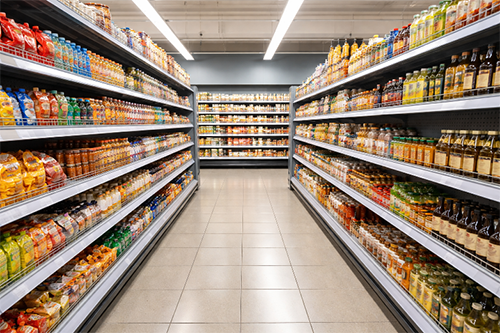
Grocery chains expanding into new markets or renovating existing store formats are making significant infrastructure decisions well before the first product hits a shelf. Among those decisions, shelving and display racking systems represent one of the most consequential investments a retail operator can make. These systems define how merchandise is organized, how staff navigate the floor, and how customers experience the store environment day to day.
For years, the default assumption in North American retail operations was that sourcing shelving locally — from regional distributors or domestic manufacturers — was simply the safer choice. Shorter lead times, familiar specifications, and accessible after-sales support made that reasoning easy to defend. But as grocery chains grow and capital efficiency becomes a higher priority, operators are asking harder questions about whether local sourcing still provides the strongest return on investment, or whether international manufacturing — particularly out of India’s established industrial hubs — deserves more serious consideration.
This comparison is not about finding the cheapest option. It is about understanding what each sourcing model actually delivers across total cost, consistency, supply reliability, and long-term operational fit.
What the Global Rack Manufacturing Market Actually Looks Like
The commercial shelving and racking industry is far more globally integrated than most retail buyers realize. Manufacturing capacity for retail display systems, gondola shelving, and modular storage racks is concentrated in several industrial regions — and India’s manufacturing corridor, particularly in cities like Chennai, has grown into one of the most capable production bases for this category of equipment. Suppliers producing supermarket racks Chennai have expanded their output and quality standards significantly over the past two decades, serving export markets across the Middle East, Southeast Asia, Africa, and increasingly, North America.
A working reference point for understanding how international manufacturing standards apply to commercial shelving is available through ISO’s published industrial standards, which govern structural integrity and material compliance across global supply chains. Many Indian manufacturers in this space hold certifications aligned with or equivalent to these standards, which matters when procurement teams are evaluating whether imported racking meets the operational requirements of a live retail environment.
How Chennai Became a Credible Rack Manufacturing Center
Chennai’s position as a manufacturing hub is not recent, but its relevance to retail infrastructure has grown more visible as international procurement strategies have matured. The city has a well-established steel fabrication base, a dense network of component suppliers, and an export-oriented industrial culture that has learned to meet demanding specifications from foreign buyers. For supermarket racking in particular, this means that buyers working with Chennai-based manufacturers are not dealing with early-stage or experimental production — they are engaging with facilities that have built systems for high-volume, high-specification commercial environments.
This matters because retail racking is not a commodity in the way that raw materials are. The engineering that goes into a gondola shelving system — its load distribution, connector design, surface treatment, and adjustability — determines how reliably it functions across years of daily use. A facility producing these systems at scale for export has typically worked through those engineering challenges already, and the result is a more consistent product than one sourced from a smaller domestic supplier filling intermittent orders.
Cost Structure Differences Between Indian and US Suppliers
The price difference between supermarket racks Chennai manufacturers and US-based suppliers is real, but the nature of that difference is often misunderstood. It is not simply a function of lower wages in India, though labor costs are a factor. The more significant driver is manufacturing scale and vertical integration. Large Indian rack manufacturers control more of their own supply chain — from steel procurement to surface coating to assembly — which reduces per-unit cost in ways that smaller domestic suppliers cannot replicate without comparable volume.
Understanding Total Landed Cost, Not Just Unit Price
Where grocery chain operators sometimes miscalculate is in comparing unit price alone without accounting for total landed cost. Importing commercial shelving from India involves freight, customs duties, port handling, and in some cases, inland logistics to the final installation site. These costs add up and can meaningfully reduce the apparent price advantage. Operators who have done this calculation carefully tend to find that the cost benefit of Indian sourcing is real but more modest than the initial quote suggests — typically meaningful for large-volume orders rather than small pilot installations.
For a growing grocery chain equipping multiple store locations, the math usually still favors international sourcing for the primary shelving infrastructure. For replacement components, accessories, or small supplemental orders, local US suppliers often provide better economics simply because the logistics burden is lower. The practical approach most experienced operators arrive at is a split strategy: source the core rack systems internationally for new builds, and maintain a relationship with a domestic distributor for ongoing operational needs.
Payment Terms, Lead Times, and Cash Flow Reality
Lead time is where local US suppliers carry a genuine operational advantage. A domestic supplier can often fulfill a shelving order within weeks. An order placed with a manufacturer in Chennai — even a well-run one — typically involves a production lead time plus ocean freight, which combined can stretch to several months. For a retail operator on a tight store opening schedule, this is not a minor logistical consideration. It requires planning discipline that not every organization has built into its project management process.
Payment terms also differ. International orders often require advance deposits or letters of credit, which affect working capital in ways that net-term domestic orders do not. Operators who have managed international procurement successfully tend to do so because they treat equipment sourcing as a capital planning activity rather than a reactive purchasing function.
Quality Consistency and Specification Compliance
One of the most common concerns raised about international sourcing for commercial shelving is quality consistency — specifically, whether a rack system produced overseas will perform to the same standard across an entire order and across repeat orders. This concern is legitimate and worth examining honestly.
The answer depends heavily on which manufacturer a buyer is working with and how that relationship is structured. A well-established manufacturer producing supermarket racks for export markets at scale has strong incentives to maintain consistent specifications, because quality failures damage the export relationships they depend on. Smaller or less export-focused manufacturers may have less rigorous quality control. The due diligence required to evaluate a manufacturer’s actual production capabilities is more demanding than it is with a domestic supplier, where a buyer can visit a facility easily and assess operations directly.
Specification Alignment and the Risk of Mismatched Components
A specific technical risk in international sourcing that retail operators should understand is specification misalignment. Rack systems need to integrate with each other — uprights, shelves, brackets, and end panels all need to fit consistently. If a buyer sources racks from an international manufacturer and later attempts to supplement with components from a US supplier, there is a meaningful risk of dimensional incompatibility. This is not a theoretical concern; it is a problem that shows up in real store environments when brackets do not seat correctly or shelves do not sit level.
Operators who manage this well do so by committing to a single supplier for each store format’s core shelving system, and by ordering spare components as part of the initial purchase rather than sourcing them reactively later. This approach also helps with warranty and replacement conversations, since a single manufacturer is accountable for the entire system rather than components spread across multiple vendors.
Which Model Serves a Growing Grocery Chain Better
The answer to this question is not the same for every operator, and that is worth stating plainly. A regional grocery chain opening its first two or three locations is in a fundamentally different position than a growing chain planning eight to twelve new stores over a two-year period. The sourcing decision that makes sense for one does not automatically apply to the other.
Scale as the Primary Decision Variable
For operators building out significant store volume, the economics of international sourcing — particularly for core shelving infrastructure — tend to produce better ROI over time. The higher per-unit cost savings compound across large orders, and a mature relationship with an established manufacturer produces more consistent results than managing multiple domestic vendors whose capacity and pricing vary. The challenge is building the internal procurement and logistics capability to manage international purchasing well, which has a real organizational cost that smaller operators may not be positioned to absorb.
Local US suppliers, for their part, offer something that international manufacturers genuinely cannot: speed and accessibility. For operators who face unpredictable store opening timelines, need to replace damaged components quickly, or are still refining their store format, domestic sourcing preserves operational flexibility in a way that long-lead international orders cannot. That flexibility has real value and should not be discounted in the ROI calculation.
Concluding Perspective
The comparison between sourcing supermarket racks from Chennai-based manufacturers and working with local US suppliers is not a question with a universal answer. It is a question that requires an operator to be honest about their scale, their planning discipline, their cash flow structure, and how much operational flexibility they need to preserve.
What is clear is that the quality and capability gap between established Indian manufacturers and US domestic suppliers has narrowed considerably. Operators who dismiss international sourcing on the assumption that it carries unacceptable quality or reliability risk are working from an outdated model of the global manufacturing market. Equally, operators who assume international sourcing is always the better deal without accounting for total landed cost, lead times, and organizational complexity are likely to be disappointed by the actual results.
The most durable sourcing strategies for growing grocery chains tend to be hybrid in nature: building primary store infrastructure through international manufacturing where volume justifies it, and maintaining domestic supplier relationships for the responsiveness that ongoing operations require. That balance — not a single-source answer — is what tends to produce the strongest long-term ROI across a retail portfolio that is genuinely growing.
