
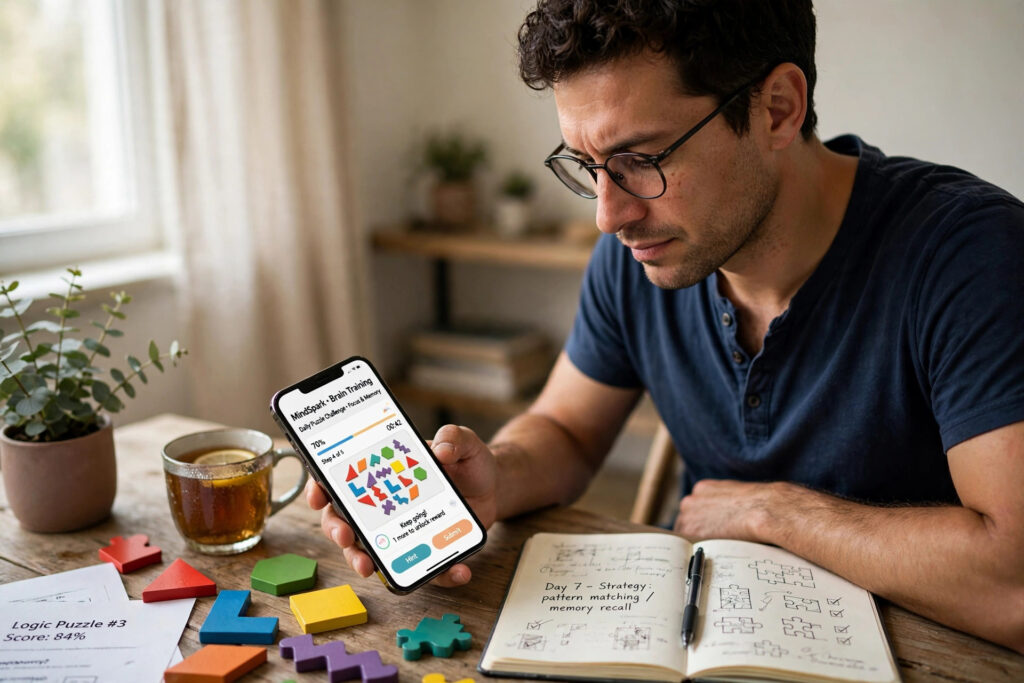
Brain-training apps promise a lot in a very small package. Spend a few minutes a day matching patterns, remembering sequences or solving quick puzzles, their marketing suggests, and you could sharpen your memory, focus faster and even protect your brain against ageing. But do brain games actually work, or do they mainly make players better at the games themselves?
That distinction is at the heart of a debate that has run for more than a decade among neuroscientists and psychologists. The short answer, according to the weight of the research, is more nuanced than either the advertising or the harshest critics suggest. Brain games do produce real improvements, but those improvements tend to be narrow, and the boldest claims about everyday intelligence and dementia prevention remain unproven.
The Promise Behind Brain-Training Apps
The idea behind brain training is appealing because it borrows from a genuine scientific concept: neuroplasticity, the brain’s ability to form and reorganise connections in response to experience. If practising the piano improves musical skill and exercise strengthens muscles, it seems reasonable to ask whether targeted mental exercises could strengthen memory, attention and processing speed.
Commercial programmes turned that question into a product. As Lumosity’s own overview of myths and facts about brain games acknowledges, the field has attracted both enthusiasm and scepticism, and claims that brain games are simply useless go too far in the opposite direction. The real question is not whether players improve at all, but how far those gains travel beyond the screen.
What Large Studies Actually Found
One of the most frequently cited trials, published in the journal Nature, involved more than 11,000 adults who trained online for six weeks. Participants improved significantly on the tasks they practised, but those gains did not transfer to untrained tasks measuring reasoning, memory or verbal skills. In other words, practice made people better at the exercises, not obviously smarter in daily life.
Later reviews reached similar conclusions. A major review of the brain-training literature, published in Psychological Science in the Public Interest, examined hundreds of studies and found extensive evidence that training improves performance on trained tasks, less evidence that it improves closely related tasks, and very little evidence that it enhances everyday cognition or prevents decline. Regulators have acted on that gap too: in 2016 the US Federal Trade Commission required Lumosity to pay two million dollars to settle charges that its advertising overstated the benefits of its games for school, work and age-related conditions.
There are, however, important exceptions. The large ACTIVE trial in the United States, which followed older adults for years, found that certain types of training, particularly speed-of-processing exercises, were associated with lasting benefits, including a lower risk of dementia in one training group at the ten-year follow-up. Researchers caution that these results apply to specific, structured programmes rather than to casual app use, but they show the picture is not entirely negative. Readers who enjoy gaming coverage can also explore how games present information to players in our explainer on visual information overlays in survival games.
Why Transfer Is So Hard to Achieve
Scientists call the core problem transfer. Learning is often highly specific: chess players develop extraordinary memory for chess positions, but that advantage largely disappears when pieces are placed randomly. Brain games appear to work the same way. A player who masters a memory game has trained a particular routine, and the brain, efficient as it is, optimises for that routine instead of upgrading general intelligence.
Study design also matters. Many positive results come from small trials without proper control groups, meaning improvements may reflect the placebo effect, expectations or simply getting comfortable with testing. When trials use active control groups, the apparent advantages often shrink considerably.
What Actually Helps Your Brain
If apps are not a shortcut, what does support cognitive health? The evidence is much stronger for unglamorous habits. Regular aerobic exercise improves blood flow to the brain and is linked to better memory and a lower risk of cognitive decline. Adequate sleep is essential for consolidating memories, while a balanced diet, managing blood pressure and staying socially and mentally active all show consistent associations with healthier ageing brains.
Learning a genuinely new skill, such as a language, a musical instrument or photography, also appears more promising than repetitive mini-games, because it challenges multiple brain systems at once and keeps demanding new effort as you progress. Games can be part of that picture: strategy games, puzzles and video games that you genuinely enjoy can provide mental stimulation, social connection and stress relief, all of which have value in themselves.
The Bottom Line
So, are brain games useless? No. They are entertaining, they can improve the specific skills they train, and some structured programmes show modest, targeted benefits, particularly for older adults. But the claim that a few minutes of app-based puzzles will broadly raise intelligence, transform job performance or reliably prevent dementia goes well beyond what the science currently supports.
The sensible approach is to treat brain-training apps like crossword puzzles: enjoyable, possibly helpful in small ways, and harmless for most people, provided expectations stay realistic and subscriptions are not mistaken for medical treatment. Anyone worried about memory loss should speak to a doctor rather than an app store. For more stories on games, technology and the science behind them, visit the OxPoll homepage.
