
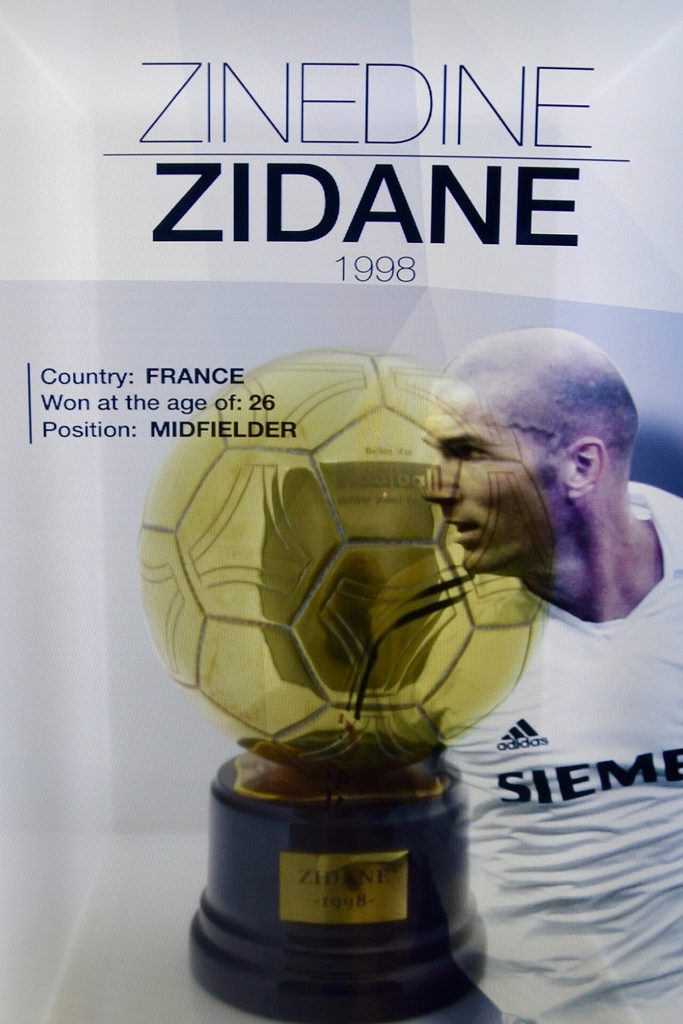
The Ballon d’Or is decided by a panel of football journalists, not by fans, players or coaches, and each juror ranks ten players on a points scale. Winners are judged on three criteria in a fixed order of priority, and the room for interpretation inside that order is why the result so often starts an argument.
Ảnh: Ank Kumar, Wikimedia Commons (CC BY-SA 4.0)
Who actually votes for the Ballon d’Or?
France Football runs the award and the vote, and the ceremony is co-hosted with UEFA. The electorate is made up of professional football journalists from around the world. For the men’s award, each country in the top 100 of the FIFA men’s ranking gets one journalist. For the women’s award, the cut-off is the top 50 of the women’s ranking.
The ranking used is the one in force on the day the nominees are announced. For the 2026 edition that date was 8 September 2026. A country just inside the cut-off has the same single voice as a football giant, which is fair in structure but means national perspective matters. A juror who watched one league closely all year, or whose memory is dominated by one big tournament, will naturally see the season differently from a juror elsewhere.
How does the points system work?
France Football’s editorial team first selects a list of 30 nominees. Each juror then picks ten players and ranks them from 1 to 10. Using the scale reported by most of the sources I checked, the points run as follows.
| Rank on the ballot | Points |
|---|---|
| 1st | 15 |
| 2nd | 12 |
| 3rd | 10 |
| 4th | 8 |
| 5th | 7 |
| 6th | 5 |
| 7th | 4 |
| 8th | 3 |
| 9th | 2 |
| 10th | 1 |
If two players finish level on points, the tiebreak is the number of first-place votes, then second-place votes, and so on down the ballots. Any other dispute is settled by the editor-in-chief of France Football.
The scale has changed over time. The table below compares the 2021 format with the current one.
| Edition | Players per ballot | Points scale |
|---|---|---|
| 2021 | 5 | 6-4-3-2-1 |
| 2026 | 10 | 15-12-10-8-7-5-4-3-2-1 |
A longer ballot lets a juror reward a player they rate sixth or seventh, which spreads credit more widely. A larger gap between first and second place also means a single juror’s top pick carries more weight than it did under the old scale.
What are the three criteria, and why does the order matter?
Jurors are asked to weigh three things, in this order of priority: individual performance, decisiveness and impact; team performance and trophies; and finally class and fair play. Trophies sit second, not first. A title can strengthen a candidate’s case but does not automatically decide the winner.
Here is a simple hypothetical. One forward posts a huge goal tally for a club that finishes without a trophy, while a midfielder is the engine of a league-winning side. Under these criteria, a juror can defensibly pick either one, depending on whether they judge the midfielder’s influence to be individual brilliance or a by-product of a strong team. That is exactly the ambiguity critics point to: the criteria are ordered, but they do not say how much one outweighs the other.
For readers who want to follow current form and standout players while forming their own view, sports and player updates are available on a general sports and football entertainment site that also hosts registration and login pages.
Why do the results keep causing arguments?
In my view, the controversy comes from three filters that sit before and around the vote, not only from the vote itself.
- Who makes the list of 30. The shortlist is chosen by France Football’s editors, so it is a subjective step. In 2025, Rodri, the previous year’s winner, was not nominated, the first time that has happened in the award’s history. Pedri, meanwhile, did not make the top 10.
- How individual form is weighed against trophies. Because the criteria leave space for interpretation, two jurors can read the same season and reach opposite conclusions.
- The calendar. The award follows the season, not the calendar year. For 2026 the window runs from 3 August 2025 to 19 July 2026 and includes international competitions. The women’s Africa Cup of Nations ended on 16 August, so it counts toward next season instead.
Ảnh: Tadpolefarm, Wikimedia Commons (CC BY-SA 4.0)
| Year | Winner | Context |
|---|---|---|
| 2021 | Lionel Messi, 613 points | Lewandowski second on 580, Jorginho third on 460; top-5 ballots at the time |
| 2024 | Rodri, 1,170 points | Vinícius Jr. of Real Madrid second on 1,129; the result was surrounded by controversy |
| 2025 | Ousmane Dembélé | Rodri not nominated; Pedri outside the top 10 |
How much can a small gap really mean?
Rodri beat Vinícius Jr. by 41 points in 2024, which sounds decisive until you convert it into ballots. Take the current scale as a hypothetical: a juror who moves a player from second to first, and the rival from first to second, shifts the margin by six points. On that simple arithmetic, about seven jurors changing their minds on the top two places would have flipped a 41-point gap. This is an illustration, not a reconstruction of the actual 2024 ballots.
That is why the tiebreak rewards first-place votes, and why a campaign narrative built around a handful of voters can matter. A narrow margin is less a verdict than a snapshot of how a few dozen opinions split.
What about the other individual awards?
The Ballon d’Or is the headline prize, but it comes with companions. In 2026 these include the women’s Ballon d’Or, voted by 50 journalists, the Kopa Trophy for the best young player, the Yashin Trophy for the best goalkeeper and the Johan Cruyff Trophy for the best coach. Other individual awards in the sport use their own electorates and criteria, which is one reason a player can win one prize and finish well down another in the same season.
If you want a general starting point for football coverage and sports content, the https://w88.inc/ homepage lists sports and football sections alongside account registration and login pages.
What should you watch next?
The 70th ceremony takes place in London on 26 October 2026, and voting closed on 28 September. When the winner is announced, check which of the three criteria their case rested on: an individual season that stood apart, or a team record that tipped the balance. That answer will tell you more about how the award is really judged than the points table does.
